Lethwei vs Muay Thai
Lethwei
- ✓Headbutts
- ✓Bareknuckle
- ✓Elbows
- ✓Knees
- ✓Kicks
- ✓Clinch fighting
- ✗Points decision (traditional)
- ✓Knockout-only (traditional)
- ✗Gloves required
Muay Thai
- ✗Headbutts
- ✗Bareknuckle
- ✓Elbows
- ✓Knees
- ✓Kicks
- ✓Clinch fighting
- ✓Points decision (traditional)
- ✗Knockout-only (traditional)
- ✓Gloves required
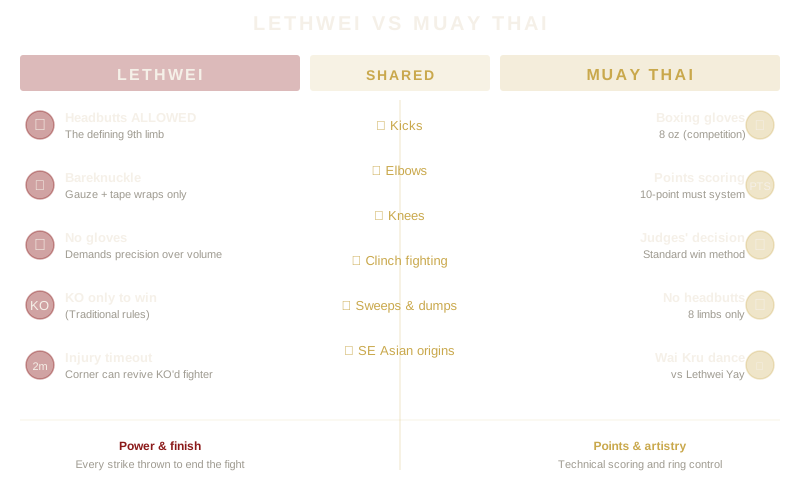
No comparison in combat sports generates more heated debate than this one. Lethwei and Muay Thai are siblings born from the same blood-soaked soil of Southeast Asia, yet centuries of divergent evolution have produced two arts that look similar on the surface and feel radically different in the ring. Understanding both requires you to go back to their shared origin: the ancient battlefield martial arts of the Tai and Bamar peoples, developed for close-quarters combat during an era when empires clashed across the jungles and river plains between the Irrawaddy and the Chao Phraya.
Both arts descend from a family of Southeast Asian fighting systems that used every natural weapon of the body. Warriors in what is now Myanmar, Thailand, Cambodia, and Laos all practised variations of this open-hand, open-elbow, knee-and-kick combat. When the Burmese king Bayinnaung sacked Ayutthaya in 1569, the Thai and Burmese martial traditions mixed again in the war camps, and the famous legend of Nai Khanomtom — the Thai boxer who allegedly defeated ten Burmese fighters in 1774 — underscores just how intertwined these arts were. Both nations were training their men in virtually the same way. The split came slowly, driven by differing rulesets, cultural priorities, and the commercial evolution of Thai boxing in the twentieth century.
The Critical Differences
The single most important difference is the headbutt. In Lethwei, the skull is the ninth weapon, and it changes everything. A Lethwei fighter in the clinch has an option that no Muay Thai fighter possesses: the ability to drive the crown of the forehead into the opponent's nose, cheekbone, or orbital ridge. This one addition alters the entire geometry of close-range combat. Clinch strategy in Muay Thai revolves around neck control, knee placement, and off-balancing. In Lethwei, the clinch is all of that plus the constant threat of a skull strike that can open a cut or produce a knockout in a fraction of a second.
The second difference is equipment. Muay Thai fighters wear eight-ounce or ten-ounce boxing gloves that protect the hands and distribute impact across a wider surface area. Lethwei fighters wrap their hands in thin gauze and tape — nothing more. Bare knuckles cut more easily, but they also break more easily. This reality discourages the high-volume jab-cross combinations you see in Muay Thai and encourages a more deliberate, power-shot approach in Lethwei. A Lethwei fighter who throws a lazy jab against hard bone risks fracturing a metacarpal in the second round and fighting one-handed for the rest of the bout.
The third difference is the win condition. Traditional Lethwei has no points and no judges. The only way to win is by knockout. If both fighters are still standing at the end of the final round, the bout is declared a draw. This rule fundamentally shapes fighting philosophy. Muay Thai fighters can afford to invest in low kicks that score points but rarely finish fights. Lethwei fighters cannot. Every technique must be measured against a single question: can this hurt him badly enough to end it? This is why Lethwei fighters tend to sit heavier on their back foot, load up on power shots, and march forward with a relentless pressure style that prioritises damage over defence.
In Muay Thai you can win by touching. In Lethwei, you can only win by hurting. That changes everything about how you train, how you think, and how you fight.Dave Leduc, WLC World Champion
Technique Overlap
Despite these differences, the technical overlap between Lethwei and Muay Thai is enormous. The roundhouse kick is executed with virtually identical mechanics — the hip turnover, the shin-on-target contact, the full rotation through the target. The teep (push kick) exists in both arts, used to manage distance and disrupt rhythm. Elbows are thrown with the same slashing, hooking, and spinning trajectories. Knees in the clinch follow the same principles of posture, neck control, and hip drive. A fighter who is technically proficient in one art will find perhaps eighty percent of the other art instantly recognisable.
The clinch in particular is nearly identical in its core mechanics. Both arts use the double collar tie, the single collar tie with underhook, and the body lock position. The sweeps and dumps are the same. The difference, again, is what you can do once you get there: in Lethwei the headbutt threat forces both fighters to keep their heads offline, creating slightly wider frames and a more cautious entry into close range.
Philosophy: Finish vs Artistry
The deepest divergence is philosophical. Modern Muay Thai, especially the stadium-era fighting at Lumpinee and Rajadamnern, evolved into a nuanced scoring art. Judges reward clean technique, balance, ring control, and composure. Aesthetics matter. A fighter who delivers a beautiful switch kick that snaps the opponent's head is rewarded more highly than a fighter who bulldozes forward throwing haymakers. Muay Thai developed an entire culture around the “muay femur” — the technician — and the sport's greatest champions, Saenchai and Somrak among them, are celebrated for elegance as much as power.
Lethwei has no such tradition. There is no aesthetic scoring, no reward for elegance in isolation. The crowd roars for damage. The culture celebrates the fighter who walks through punishment to deliver punishment. Myanmar's greatest Lethwei fighters — Too Too, Tun Tun Min, Lone Chaw — are remembered for their ferocity, their iron chins, and their willingness to trade in the pocket. This is not to say Lethwei fighters lack skill; many are devastatingly precise. But the skill is always in service of one goal: the finish.
Which Produces Better MMA Fighters?
This question has no clean answer, but it is worth examining. Muay Thai has produced far more successful MMA fighters for the simple reason that it has a vastly larger global talent pool and infrastructure. Fighters like Anderson Silva, Valentina Shevchenko, and Joanna Jedrzejczyk all built their MMA striking on a Muay Thai base. Lethwei's MMA contributions are smaller in number but no less significant in principle. A Lethwei-trained striker enters the cage with comfort in the clinch, familiarity with dirty boxing range, and a mental toughness forged by bouts where the only acceptable outcome is a knockout.
The bareknuckle training also builds hand conditioning that translates well to four-ounce MMA gloves, which are much closer to bare fists than to boxing gloves. Where a Muay Thai fighter might need to adjust their punching mechanics downward for lighter gloves, a Lethwei fighter is already calibrated for that impact.
Can a Muay Thai Fighter Compete in Lethwei?
Absolutely — and in fact Muay Thai is the single best crossover base for Lethwei competition. The technical overlap is so large that an experienced nak muay can step into a Lethwei ring and be competitive from day one, provided they make three adjustments: learn to use the headbutt, learn to defend the headbutt, and recalibrate their mental approach from points to finishes. Several Thai fighters have made this transition successfully, and the cross-promotion bouts between WLC and major Muay Thai organisations have produced some of the most exciting fights in recent memory.
The most famous crossover moment came in 2018, when Dave Leduc — the Canadian-born WLC champion who had trained extensively in both arts — faced the Thai legend Diesellek Sor Porntawee under hybrid rules. The fight demonstrated exactly what happens when a Muay Thai fighter of the highest calibre encounters the headbutt and the bareknuckle reality of Lethwei. Diesellek, a decorated stadium fighter with hundreds of bouts, had all the tools to compete but found himself in unfamiliar territory every time the range collapsed and Leduc's forehead became a weapon. It remains one of the most-watched Lethwei fights in history and a landmark in the art's international exposure.
Lethwei vs Boxing
Lethwei
- ✗Punches only
- ✓Kicks
- ✓Elbows
- ✓Knees
- ✓Headbutts
- ✓Clinch fighting
- ✓Bareknuckle
- ✗Points decision
Boxing
- ✓Punches only
- ✗Kicks
- ✗Elbows
- ✗Knees
- ✗Headbutts
- ✗Clinch fighting
- ✗Bareknuckle
- ✓Points decision
Comparing Lethwei to Western boxing is an exercise in contrasting maximalism with minimalism. Boxing restricts itself to punches from the waist up, delivered with padded gloves under a highly refined ruleset that has been polished over two centuries. Lethwei allows punches, kicks, knees, elbows, and headbutts, delivered bareknuckle in a format that is closer to a raw combat simulation than a sporting contest. Yet these two arts respect each other deeply, and the exchange of knowledge between them has enriched both.
The range game is where the difference is most obvious. A skilled boxer operates in a narrow band of distance — too far and the punches don't land, too close and the leverage disappears. Within that band, boxing is an extraordinarily sophisticated science. Footwork angles that would make a ballroom dancer weep, head movement that turns the torso into a pendulum, and combination punching that chains three, four, five shots together in a single rhythmic burst. Lethwei fighters rarely work in that narrow band because they have weapons at every range: kicks at long distance, knees and elbows at medium, headbutts and short punches in the phone booth. A Lethwei fighter does not need to master the subtlety of the jab-cross-hook because they have a teep, a roundhouse, and a skull to fill the gaps.
The bareknuckle punching mechanics differ in important ways. Gloved boxing encourages a closed-fist, knuckle-forward impact where the padding distributes force across the hand. Bareknuckle punching, as practised in Lethwei, often favours slightly different fist angles — a more vertical fist on hooks to protect the small knuckles, a tendency to target softer tissue like the body and the temple rather than the hard frontal bone of the skull. Lethwei fighters also use the palm strike and hammer fist more freely than gloved boxers, because without gloves these strikes are practical and effective.
What Each Art Borrows From the Other
Boxers who study Lethwei gain insight into the dirty boxing range — the clinch-adjacent space where elbows, collar ties, and short punches dominate. Many boxing coaches quietly acknowledge that the inside game of Lethwei mirrors what great infighters like Roberto Duran and Joe Frazier did instinctively: using the head as a frame, grinding in the clinch, and punishing the body at point-blank range. The difference is that Lethwei codifies this into a formal system rather than leaving it to individual improvisation.
Lethwei fighters who study boxing gain something equally valuable: footwork and combination flow. Traditional Lethwei training in Myanmar emphasises toughness and single-shot power over fluid multi-punch sequences. A Lethwei fighter who adds boxing-style lateral movement, level changes, and three-punch combinations to their arsenal becomes dramatically more dangerous. Dave Leduc and other internationally trained Lethwei fighters have demonstrated exactly this synthesis, blending Western boxing footwork with the full Lethwei weapon set to create a hybrid that is extremely difficult to deal with.
The rise of Bare Knuckle Fighting Championship in the United States has created an unexpected bridge between boxing culture and Lethwei awareness. BKFC, which launched in 2018 and has since grown into a significant combat sports promotion, strips the gloves from boxing and allows fighters to compete with wrapped but unpadded fists. The resulting spectacle — faster cuts, more dramatic knockouts, and a rawness that gloved boxing cannot replicate — has drawn millions of viewers who are discovering for the first time that bareknuckle striking has been the standard in Myanmar for centuries. BKFC operates under modified boxing rules with punches only, so it lacks Lethwei's kicks, elbows, knees, and headbutts, but the shared DNA is unmistakable. Commentators and fighters within the BKFC ecosystem regularly reference Lethwei as the original and most complete bareknuckle striking art, and this exposure has driven a measurable increase in international interest in Lethwei training and competition. For Lethwei, the BKFC boom is validation: the world is finally beginning to understand what Myanmar's fighters have always known about what happens when the gloves come off.
Hand positioning and guard structure reveal a fundamental tactical divergence between the two arts. A boxing guard is designed to protect against punches arriving from a narrow cone of angles — the high guard tucks the gloves against the temples and chin, the philly shell angles the lead shoulder forward, and the peek-a-boo style buries the face behind both fists. All of these guards rely on the padding of the gloves to absorb and deflect blows. In Lethwei, the guard must account for a far wider threat matrix: kicks to the head, elbows from oblique angles, knees rising from below, and headbutts driving forward through the centreline. The Lethwei guard therefore sits higher and tighter, with the forearms more vertical and the elbows tucked closer to the body. The chin is buried deeper because there is no glove cushion to soften a clean strike. Fighters often keep one hand higher than a boxer would, nearly at forehead level, specifically to frame against incoming headbutts. This guard sacrifices some of the fluidity and hand-speed that boxing guards enable, but it provides a more complete defensive shell against the full spectrum of Lethwei weapons.
Boxing footwork — widely regarded as the most sophisticated in all of combat sports — is both a tremendous asset and a subtle liability in the Lethwei context. The lateral movement, the pivot, the step-and-slide that allow a boxer to create angles and avoid being pinned on the ropes translate directly into ring-cutting and evasion skills that many traditional Lethwei fighters lack. A boxer who enters Lethwei with good feet can make opponents miss and create openings that flat-footed pressure fighters cannot. However, boxing footwork is built on a relatively narrow, bladed stance that prioritises mobility over base stability. In Lethwei, this stance creates vulnerability: the narrow base is easier to sweep or dump from the clinch, the bladed position exposes the lead leg to devastating low kicks, and the constant lateral movement can draw a fighter into clinch range where the headbutt and elbow await. The best Lethwei-boxing hybrids — fighters who have genuinely synthesised both arts — solve this problem by widening the boxing stance slightly, staying heavier on the back foot to check kicks, and using lateral movement in bursts rather than as a constant rhythm. The footwork becomes a weapon of surprise rather than a default mode.
Lethwei vs MMA
Lethwei
- ✓Headbutts
- ✓Bareknuckle
- ✓Kicks/elbows/knees
- ✗Ground fighting
- ✗Submissions
- ✗Wrestling/takedowns
- ✗Bouts decided by judges
- ✓Single-art purity
MMA
- ✗Headbutts
- ✗Bareknuckle
- ✓Kicks/elbows/knees
- ✓Ground fighting
- ✓Submissions
- ✓Wrestling/takedowns
- ✓Bouts decided by judges
- ✗Single-art purity
Mixed martial arts is the laboratory where every traditional style gets tested against the others, and Lethwei has a fascinating relationship with it. On the feet, a Lethwei fighter is among the most dangerous strikers in any cage. The comfort with bareknuckle impact, the willingness to eat a shot to deliver a harder one, the clinch dominance, the elbow and knee arsenal — all of this translates beautifully to the stand-up phase of an MMA bout. Four-ounce MMA gloves are much closer to bare fists than to boxing gloves, so the Lethwei fighter's punching mechanics require minimal adjustment.
But MMA is not a stand-up fight, and this is where Lethwei's limitation becomes painfully clear. The art has no ground game whatsoever. There are no submissions, no guard work, no takedown defence drills in a traditional Lethwei camp. A pure Lethwei fighter taken to the mat by a competent wrestler or jiu-jitsu player is a fish on dry land. This is not a criticism of the art itself — Lethwei was never designed for ground fighting, just as boxing was never designed for kicks — but it means that a Lethwei fighter entering MMA must invest heavily in grappling to become a complete mixed martial artist.
A Lethwei fighter in an MMA cage is like a medieval knight with the finest sword but no shield. The stand-up is devastating, but the moment the fight goes to the ground, the weapon is useless.
The fighters who have successfully crossed over from Lethwei to MMA have uniformly done so by pairing their striking with extensive wrestling and submission training. The stand-up advantage they carry is real and significant: comfort in the pocket, familiarity with dirty boxing, devastating elbows from the clinch, and an almost supernatural tolerance for taking punishment. These are qualities that MMA coaches prize highly. The missing piece is always time on the mat.
Looking at it from the other direction, MMA fighters who train Lethwei-specific techniques — particularly the headbutt entries from the clinch and the bareknuckle hand conditioning — report significant improvements in their dirty boxing and close-range striking. Even though headbutts are illegal in sanctioned MMA, the body mechanics and positional awareness that come from headbutt training improve a fighter's overall clinch game. You learn to control head position, to use your forehead as a frame, and to generate short-range power in ways that conventional striking camps rarely teach.
Lethwei vs Kickboxing
Lethwei
- ✓Punches
- ✓Kicks
- ✓Elbows
- ✓Knees
- ✓Headbutts
- ✓Clinch fighting
- ✓Bareknuckle
- ✗Points decision
Kickboxing
- ✓Punches
- ✓Kicks
- ✗Elbows
- ✗Knees
- ✗Headbutts
- ✗Clinch fighting
- ✗Bareknuckle
- ✓Points decision
Kickboxing — whether in its K-1, Glory, or American-rules variants — shares kicks and punches with Lethwei but differs sharply in philosophy, pacing, and ruleset. Kickboxing generally prohibits elbows, forbids clinch work beyond a brief exchange, and uses a points-based scoring system where clean technique is rewarded. The result is a faster, more fluid, more aesthetically pleasing fighting style that prioritises speed and volume over raw destructive power.
The absence of headbutts and elbows in kickboxing means the range game is cleaner and more predictable. Kickboxers can commit to long combinations without fear of an elbow counter at the end, and they can enter the clinch without the threat of a skull strike. This makes kickboxing a more approachable spectator sport — the action is continuous, the techniques are visually clear, and the knockouts are spectacular — but it also means kickboxing exists in a narrower tactical space than Lethwei.
A Lethwei fighter watching a Glory Kickboxing championship sees beautiful striking but also sees opportunities everywhere. The wide stances that generate power in kickboxing are vulnerable to sweeps and dumps in Lethwei rules. The long, reaching jabs that control distance in kickboxing would be punished by headbutt entries in Lethwei. The high guards that protect against head kicks leave the body exposed to the short knees and elbows that Lethwei fighters deploy at close range. Conversely, a kickboxer watching Lethwei sees a more brutal but less fluid style, with longer pauses between exchanges and a heavier emphasis on single-shot power over combination work.
The specific rule differences between major kickboxing organisations and Lethwei deserve closer examination. GLORY kickboxing bouts are fought over three three-minute rounds with an optional extra round, and clinch work is broken up almost immediately by the referee — fighters are given one strike in the clinch before being separated. K-1 rules are even stricter on the clinch, effectively eliminating it as a tactical phase altogether. Both organisations prohibit elbows entirely and score fights on a ten-point-must system borrowed from boxing. Lethwei, by contrast, fights five rounds of three minutes each under traditional rules, allows extended clinch exchanges with knees, elbows, headbutts, and throws, and historically has no scoring system at all. The result is that kickboxing produces specialists in the mid-range striking exchange — the space between kicking distance and clinch — while Lethwei produces fighters who are comfortable at every distance, especially the gruelling close-quarters range that kickboxing rules deliberately eliminate.
A kickboxer transitioning to Lethwei faces a profound technical adjustment centred on the clinch. In kickboxing, the clinch is a momentary event — you grab, you land one knee or one short punch, and the referee separates you. Kickboxers therefore invest almost no training time in sustained clinch fighting. In Lethwei, the clinch is where a huge proportion of damage is dealt: grinding elbow strikes, vicious short knees to the body and thighs, and the ever-present headbutt that can split a forehead open in an instant. A kickboxer who enters a Lethwei clinch without preparation will instinctively try to disengage or wait for a referee break that will never come. The mental rewiring required is substantial — the kickboxer must learn to view the clinch not as a pause in the action but as the most dangerous phase of the fight.
The bareknuckle factor reshapes punch selection in ways that are not immediately obvious. Kickboxers wearing ten-ounce gloves can throw long, snapping jabs repeatedly without worrying about hand injuries. They can hook to the top of the skull, throw overhand rights that land on the forehead, and fire off rapid four- and five-punch combinations with relative impunity because the padding absorbs most of the skeletal impact. Remove the gloves, and all of that changes. Bare knuckles break on hard bone. A Lethwei fighter must choose targets more carefully — the temple, the jaw, the liver, the floating ribs — and avoid the crown of the skull and the forehead with straight punches. This selectivity means fewer combinations but more precise, devastating single shots. The jab becomes a range-finder rather than a point-scorer. The cross becomes a commitment — you throw it when you see an opening, not to fill dead space. Kickboxers accustomed to high-volume output find this adjustment extremely difficult; they must retrain themselves to be patient and deliberate where they were once fluid and prolific.
Cross-style matchups between kickboxers and Lethwei fighters remain rare but illuminating. When the World Lethwei Championship began attracting international talent in the mid-2010s, several fighters with kickboxing backgrounds entered the roster. The pattern was consistent: those who adapted their clinch game and embraced the bareknuckle reality found success, while those who tried to fight a kickboxing match under Lethwei rules were overwhelmed at close range. Cyrus Washington, an American with a strong kickboxing foundation, became one of the more notable crossover stories by blending his long-range kicking with newly developed clinch and headbutt skills. Going the other direction, Lethwei fighters who have competed under kickboxing rules often struggle with the pace and volume demands — they are accustomed to measuring out power shots over five rounds, not sustaining a high output for three. The adjustment is a mirror image: kickboxers must learn to slow down and commit, while Lethwei fighters must learn to speed up and sustain.
Lethwei vs Kun Khmer / Pradal Serey
Lethwei
- ✓Punches
- ✓Kicks
- ✓Elbows
- ✓Knees
- ✓Clinch fighting
- ✓Headbutts
- ✓Bareknuckle (traditional)
- ✓Distinctive elbow emphasis
Kun Khmer
- ✓Punches
- ✓Kicks
- ✓Elbows
- ✓Knees
- ✓Clinch fighting
- ✗Headbutts
- ✓Bareknuckle (traditional)
- ✓Distinctive elbow emphasis
Kun Khmer, also known as Pradal Serey, is Cambodia's national striking art, and it shares more DNA with Lethwei than any other martial art on this list. Both descend from the ancient Indic-influenced martial traditions of mainland Southeast Asia. Both use punches, kicks, elbows, and knees. Both were forged in centuries of warfare between neighbouring empires. The Khmer and Bamar peoples fought each other for generations, and their martial arts evolved in parallel, influenced by the same climate, the same terrain, and the same combat realities.
The critical difference is the headbutt. Kun Khmer, like Muay Thai, does not permit the use of the head as a striking weapon. This single prohibition creates the same cascade of tactical differences that separates Lethwei from Muay Thai: the clinch is less dangerous, the close-range game is more predictable, and the overall fighting style tends toward a more rhythm-based, scoring-oriented approach. Kun Khmer also uses gloves in its modern competition format, further aligning it with the Muay Thai model.
The historical rivalry between Myanmar and Cambodia adds a layer of national pride to any comparison between these arts. Cambodian martial artists argue that Kun Khmer is the original Southeast Asian striking art, predating both Muay Thai and Lethwei, citing the bas-reliefs at Angkor Wat that depict warriors using knees, elbows, and clinch techniques. Burmese practitioners counter with their own ancient lineage, pointing to Pyu-era inscriptions and the unbroken tradition of sandpit fighting in Myanmar's rural villages. The historical truth is likely that all three arts — Lethwei, Muay Thai, and Kun Khmer — emerged from a shared proto-martial art that was practised across the region long before modern borders existed.
The shared Southeast Asian heritage runs deeper than most casual observers realise. Both Lethwei and Kun Khmer trace their lineage to the military training systems of the great mainland empires — the Khmer Empire at its zenith in the twelfth and thirteenth centuries, and the Bagan Kingdom that flourished in what is now central Myanmar during the same period. Soldiers in both civilisations trained in close-quarters striking arts that emphasised the use of elbows, knees, and clinch throws, weapons designed for the chaotic press of battlefield combat where swords were lost and shields were broken. The Angkor bas-reliefs at Bayon temple depict warriors in postures unmistakably similar to modern Kun Khmer stances, while Bagan-era palm-leaf manuscripts describe training methods that mirror the conditioning drills still used in rural Lethwei camps today. These arts are not merely similar — they are branches from the same ancient root, separated by geography and politics rather than by fundamental martial philosophy.
Beyond the headline difference of the headbutt, the two arts diverge in subtle but significant technical ways. Kun Khmer fighters tend to adopt a slightly narrower stance with more weight on the front foot, facilitating the quick switch kicks and rapid elbow combinations for which Cambodian fighters are renowned. Lethwei stances are generally wider and more grounded, with weight distributed more evenly or even biased toward the rear foot, providing a stable base for absorbing and delivering heavy blows. In the clinch, Kun Khmer practitioners favour a tighter, more upright neck-wrestling position and are known for their devastating downward elbows thrown from the plum position — sharp, slicing strikes angled at roughly forty-five degrees that target the crown and eyebrow ridge. Lethwei clinch work is more varied in its elbow angles, incorporating horizontal slashes, upward cuts from below the line of sight, and spinning back elbows that are relatively uncommon in Cambodian competition. The knee game also differs: Kun Khmer fighters excel at rapid-fire straight knees to the midsection delivered in staccato bursts, while Lethwei fighters tend to throw fewer but heavier curving knees aimed at the ribs and the thigh, designed to break the opponent's body over time rather than to score quick combinations.
The political and nationalistic dimension of the Lethwei versus Kun Khmer rivalry cannot be overstated. In both Myanmar and Cambodia, the national striking art is woven into the fabric of identity, and claims of primacy are taken deeply seriously. Cambodian cultural authorities have campaigned to have Kun Khmer recognised by UNESCO as a distinct intangible cultural heritage, partly to distinguish it from Muay Thai but also to assert its seniority over all Southeast Asian striking arts, Lethwei included. Burmese practitioners view this as a challenge to their own ancient lineage and point to the unbroken continuity of bareknuckle fighting in Myanmar's villages as evidence that Lethwei has preserved the oldest form of the shared tradition. These debates mirror the better-known Muay Thai versus Kun Khmer controversy and often intensify during international competitions where Myanmar and Cambodian fighters share a card. The rivalry is genuine, occasionally bitter, and ultimately a testament to how deeply both nations care about their martial heritage.
Cross-border competition between Lethwei and Kun Khmer fighters has occurred sporadically at regional events and international showcases, though far less frequently than the Muay Thai versus Kun Khmer matchups that are a regular feature of Southeast Asian fight cards. When these bouts do happen, they are invariably fought under modified rules — typically Muay Thai or international kickboxing rules that remove the headbutt and mandate gloves, which effectively neutralises Lethwei's most distinctive weapon. Under these conditions, the contests are remarkably even. Cambodian fighters bring superior hand speed and elbow precision, while Burmese fighters bring a heavier clinch game and greater comfort absorbing punishment. The most telling matchups have occurred under hybrid rulesets that allow some but not all Lethwei weapons — in these fights, the Burmese fighters' comfort with close-range brutality tends to give them an edge in the later rounds, as the pace slows and the clinch becomes more prominent. A truly definitive cross-style comparison would require bouts under full Lethwei rules, which remains a rare occurrence outside Myanmar.
Lethwei vs Muay Boran
Lethwei
- ✓Punches/kicks/elbows/knees
- ✓Headbutts
- ✓Throws and sweeps
- ✓Bareknuckle (historic)
- ✓Practiced as live competition
- ✓Modern professional circuit
- ✗Treated mainly as preserved art
Muay Boran
- ✓Punches/kicks/elbows/knees
- ✓Headbutts
- ✓Throws and sweeps
- ✓Bareknuckle (historic)
- ✗Practiced as live competition
- ✗Modern professional circuit
- ✓Treated mainly as preserved art
This is the oldest and most provocative comparison on our list, because it forces us to ask a fundamental question: are Lethwei and Muay Boran the same art? The answer is both yes and no. Muay Boran — literally “ancient boxing” in Thai — refers to the pre-modern, pre-rules era of Thai martial arts, a time when fighters used headbutts, fought with hemp-wrapped hands, and competed in matches with no time limits and no judges. If that description sounds identical to traditional Lethwei, that is because it essentially is.
During the centuries of Thai-Burmese warfare, the martial traditions of both peoples were in constant contact. Prisoners of war taught their captors, soldiers observed enemy techniques on the battlefield, and both kingdoms absorbed what worked. The fighting systems that existed in Siam and Burma during the sixteenth, seventeenth, and eighteenth centuries were so similar as to be virtually indistinguishable. Both used headbutts. Both wrapped the hands in cotton or hemp. Both fought in sand or earth rings. Both used the full spectrum of strikes. The arts were, for all practical purposes, regional dialects of the same martial language.
The fist of the Bamar and the fist of the Siamese are forged in the same fire. Only the names are different.Traditional Burmese proverb
The divergence began in the early twentieth century when Thailand modernised its boxing. King Rama VII formalised rules, introduced boxing gloves, weight classes, timed rounds, and judging criteria. Headbutts were banned. The sand ring gave way to the elevated canvas ring. Muay Thai became a regulated, commercialised sport with stadiums, gambling, and international appeal. Muay Boran was left behind as a historical curiosity, preserved in demonstrations and cultural performances but rarely practised as a live fighting art.
Myanmar never underwent the same modernisation. While Thailand was building Lumpinee Stadium and hosting thousands of sanctioned bouts per year, Myanmar's rural villages continued holding Lethwei matches in the old way: bareknuckle, in the sand, knockout only, with headbutts. The result is that modern Lethwei is arguably the closest living approximation of what Muay Boran actually looked like in practice. When historians want to understand how ancient Southeast Asian warriors fought, they do not look at modern Muay Thai with its gloves and scoreboards. They look at a Lethwei match in a Burmese village, where the sand, the wraps, and the headbutts remain unchanged from half a millennium ago.
Self-Defense Comparison Table
The following table offers a practical comparison across several categories that matter to someone choosing a martial art for real-world self-defence. Ratings are general assessments based on the art as typically taught, not on individual outliers or hypothetical perfect practitioners.
| Category | Lethwei | Muay Thai | Boxing | MMA | Kickboxing |
|---|---|---|---|---|---|
| Range of Techniques | Excellent | Very Good | Limited | Excellent | Good |
| Street Applicability | Excellent | Very Good | Good | Excellent | Good |
| Time to Competence | 12–18 months | 6–12 months | 3–6 months | 18–24 months | 6–12 months |
| Physical Demands | Extreme | Very High | High | Extreme | High |
| Availability | Very Rare | Widespread | Universal | Widespread | Common |
Lethwei scores highest on technique range and street applicability because it trains all natural weapons of the body in a bareknuckle context that mirrors real-world violence more closely than any gloved sport. Its weaknesses are practical: very few gyms outside Myanmar teach authentic Lethwei, the physical demands are extreme, and the learning curve is steep because you are simultaneously developing striking skill and conditioning your body to deliver and absorb unpadded impact. For most people seeking practical self-defence, Muay Thai offers the best balance of effectiveness and accessibility. But for those willing to commit fully and who have access to qualified instruction, Lethwei produces a level of combat readiness that is difficult to match.